Stabilization and solidification of electroplating sludge in cement-based mortars: effects of rice husk ash on compressive strength and heavy-metal leachability

Document Type : Original Article

Authors
Department of Environmental Engineering, Faculty of Environment, University of Tehran, Tehran, Iran
Abstract
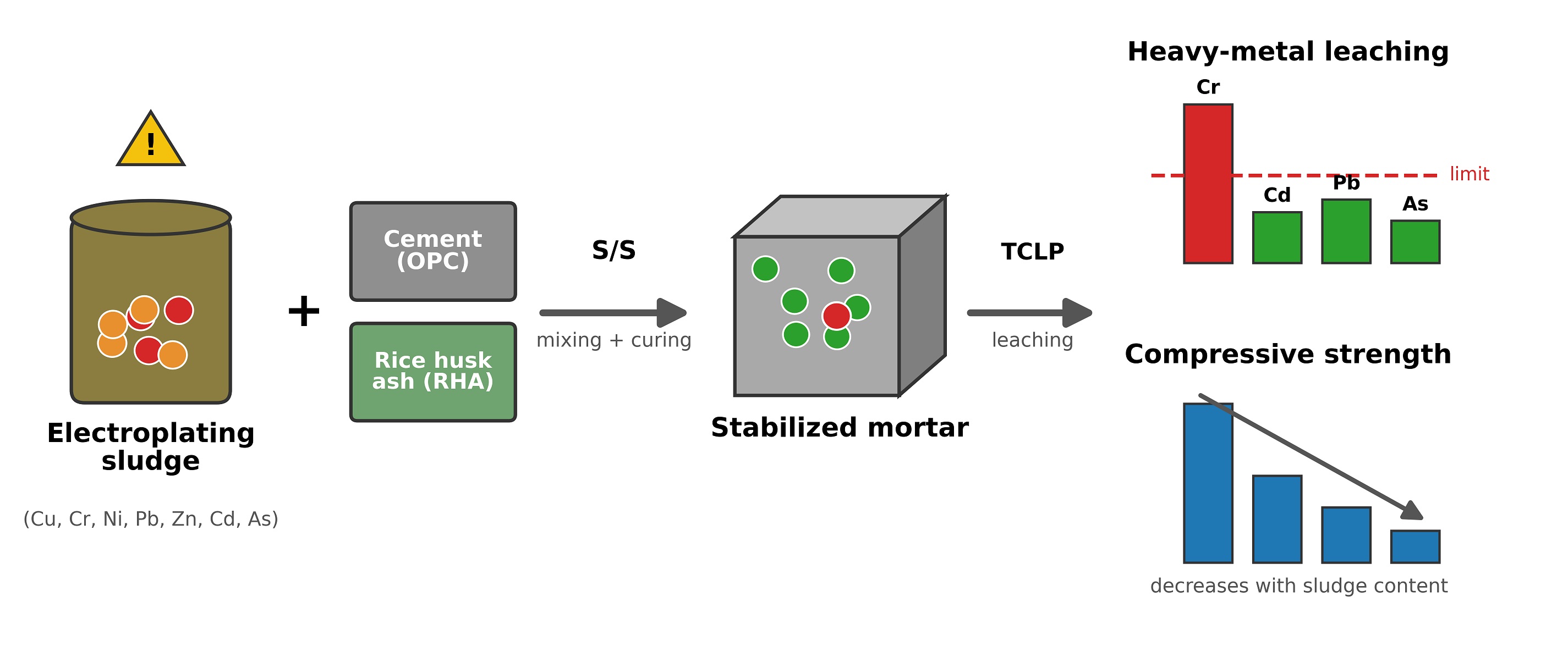
Electroplating generates large volumes of heavy-metal-bearing sludge whose secondary environmental burden can exceed that of the wastewater itself, yet a unified, reliably safe disposal route is still lacking. This study examined the stabilization/solidification (S/S) of electroplating sludge (ES) in cement-based mortars and assessed rice husk ash (RHA) as a complementary matrix for immobilizing the contained metals. Twelve mortar mixes were prepared: a plain Portland cement mortar (mix F) and eleven mixes organized into three groups, comprising ES introduced into the binder phase at 0-75 % of the cement mass together with RHA at 5 % (Group A) or 10 % (Group B) of the cement mass, and ES used as a partial fine-aggregate replacement at 15-35 % by volume (Group C). Fresh-state behavior (slump, setting time, specific gravity), unconfined compressive strength at 7, 28 and 90 days, and the leaching of Cd, Pb, Ni, Cr, As and Cu were measured. Replacing fine aggregate with ES raised the slump from 75 to 150 mm, whereas increasing the ES content of the binder progressively retarded setting, an effect amplified by a higher RHA content. Compressive strength fell sharply once ES entered the binder, from 16.3-29.0 MPa for the sludge-free mixes to 0.30-6.1 MPa at ES/CEM ratios of 25-75 %, and the 28- and 90-day values were almost identical, so that no late-age recovery should be expected. Used as a fine aggregate, ES was far less damaging, with the mortars retaining 22-53 % of the control strength. Leaching tests conducted under an identical protocol on the raw sludge and on the mortars showed that Cd, Pb and As were immobilized below their US EPA regulatory levels, whereas Cr remained above the 5 mg/L limit in every sludge-bearing mix. The results delimit the loadings over which ES can be incorporated into cementitious materials and identify chromium leaching as the principal constraint on safe reuse.

Graphical Abstract

Stabilization and solidification of electroplating sludge in cement-based mortars: effects of rice husk ash on compressive strength and heavy-metal leachability

Highlights

  •          Electroplating sludge was stabilized in cement mortars with rice husk ash.
  •          Raw sludge exceeded regulatory limits for every heavy metal measured.
  •          Compressive strength fell sharply as sludge replaced cement in the binder.
  •          Using sludge as fine aggregate preserved higher strength and workability.
  •       Cd, Pb, and As were immobilized, but Cr leaching exceeded the limit.

Keywords
Subjects

Adenuga, A. A., Amos, O. D., Oyekunle, J. A. O., & Umukoro, E. H. (2019). Adsorption performance and mechanism of a low-cost biosorbent from spent seedcake of Calophyllum inophyllum in simultaneous cleanup of potentially toxic metals from industrial wastewater. Journal of Environmental Chemical Engineering, 7(5), 103317. https://doi.org/10.1016/j.jece.2019.103317
Asavapisit, S., & Macphee, D. E. (2007). Immobilization of metal-containing waste in alkali-activated lime–RHA cementitious matrices. Cement and Concrete Research, 37(5), 776–780. https://doi.org/10.1016/j.cemconres.2007.02.003
ASTM International. (2003). Standard test method for slump of hydraulic cement concrete (ASTM C143/C143M-03). https://doi.org/10.1520/C0143_C0143M-03ASTM International. (2005). Standard specification for coal fly ash and raw or calcined natural pozzolan for use in concrete (ASTM C618-05).
ASTM International. (2008). Standard test methods for time of setting of hydraulic cement by Vicat needle (ASTM C191-08). https://doi.org/10.1520/C0191-08
ASTM International. (2009). Standard test method for density (unit weight), yield, and air content (gravimetric) of concrete (ASTM C138/C138M-09). https://doi.org/10.1520/C0138_C0138M-09
ASTM International. (2011). Standard practice for mechanical mixing of hydraulic cement pastes and mortars of plastic consistency (ASTM C305-11). https://doi.org/10.1520/C0305-11
ASTM International. (2016). Standard test method for compressive strength of hydraulic cement mortars (using 2-in. or [50-mm] cube specimens) (ASTM C109/C109M-16a). https://doi.org/10.1520/C0109_C0109M-16A
Balali-Mood, M., Naseri, K., Tahergorabi, Z., Khazdair, M. R., & Sadeghi, M. (2021). Toxic mechanisms of five heavy metals: Mercury, lead, chromium, cadmium, and arsenic. Frontiers in Pharmacology, 12, 643972. https://doi.org/10.3389/fphar.2021.643972
Bocanegra, J. J. C., Mora, E. E., & González, G. I. C. (2019). Galvanic sludges: Effectiveness of red clay ceramics in the retention of heavy metals and effects on their technical properties. Environmental Technology & Innovation, 16, 100459. https://doi.org/10.1016/j.eti.2019.100459
Chandrasekhar, S., Satyanarayana, K. G., Pramada, P. N., Raghavan, P., & Gupta, T. N. (2003). Review: Processing, properties and applications of reactive silica from rice husk—an overview. Journal of Materials Science, 38(15), 3159–3168. https://doi.org/10.1023/A:1025157114800
Chang, J. E., Lin, T. T., Ko, M. S., & Liaw, D. S. (1999). Stabilization/solidification of sludges containing heavy metals by using cement and waste pozzolans. Journal of Environmental Science and Health, Part A: Toxic/Hazardous Substances and Environmental Engineering, 34(5), 1143–1160. https://doi.org/10.1080/10934529909376887
Chen, H., Yuan, H., Mao, L., Hashmi, M. Z., Xu, F., & Tang, X. (2020). Stabilization/solidification of chromium-bearing electroplating sludge with alkali-activated slag binders. Chemosphere, 240, 124885. https://doi.org/10.1016/j.chemosphere.2019.124885
Chen, Q., Zhang, L., Ke, Y., Hills, C., & Kang, Y. (2009). Influence of carbonation on the acid neutralization capacity of cements and cement-solidified/stabilized electroplating sludge. Chemosphere, 74(6), 758–764. https://doi.org/10.1016/j.chemosphere.2008.10.044
Chen, R., Cai, G., Dong, X., Pu, S., Dai, X., & Duan, W. (2022). Green utilization of modified biomass by-product rice husk ash: A novel eco-friendly binder for stabilizing waste clay as road material. Journal of Cleaner Production, 376, 134303. https://doi.org/10.1016/j.jclepro.2022.134303
Chen, Y. L., Chang, J. E., Lai, Y. C., & Ko, M. S. (2012). Effects of sintering atmosphere on cement clinkers produced from chromium-bearing sludge. Journal of the Air & Waste Management Association, 62(5), 587–593. https://doi.org/10.1080/10962247.2012.665012
Chiu, A. C., Akesseh, R., Moumouni, I. M., & Xiao, Y. (2019). Laboratory assessment of rice husk ash (RHA) in the solidification/stabilization of heavy metal contaminated slurry. Journal of Hazardous Materials, 371, 62–71. https://doi.org/10.1016/j.jhazmat.2019.02.051
Dai, Z., Wu, Y., Hu, L., Zhang, W., & Mao, L. (2019). Evaluating physical-mechanical properties and long periods environmental risk of fired clay bricks incorporated with electroplating sludge. Construction and Building Materials, 227, 116716. https://doi.org/10.1016/j.conbuildmat.2019.116716
Della, V. P., Kühn, I., & Hotza, D. (2002). Rice husk ash as an alternate source for active silica production. Materials Letters, 57(4), 818–821. https://doi.org/10.1016/S0167-577X(02)00879-0
Deng, Y., & Zhao, R. (2015). Advanced oxidation processes (AOPs) in wastewater treatment. Current Pollution Reports, 1(3), 167–176. https://doi.org/10.1007/s40726-015-0015-z
Deutsches Institut für Normung. (2016). Methods of testing cement—Part 1: Determination of strength (DIN EN 196-1:2016-11). https://doi.org/10.31030/2482416
Fathollahi, R., Shahmoradi, M., Babamoradi, R., & Abkhiz, M. (2025, December 17–19). Investigation of the effect of rice husk ash as a pozzolan on the compressive strength of high strength concrete produced with local materials of Ilam [Paper presentation]. 11th National Congress on Civil Engineering, Architecture, Art and Urban Development, Tehran, Iran (In Persian). https://civilica.com/doc/2666534
Hashim, A. A., Abdul Kadir, A., Sarani, N. A., Hassan, M. I. H., Kersnansamy, A., & Abdullah, M. M. A. B. (2022). Immobilization of metals in fired clay brick incorporated with aluminium-rich electroplating sludge: Properties and leaching analysis. Sustainability, 14(14), 8732. https://doi.org/10.3390/su14148732
Jafarpour, F., Majedi, M. H., & Ramezanianpour, A. (1997). Making of masonry cement with rice husk. Building and Housing Research Center, Tehran, Iran. (In Persian).
Jochem, L. F., Casagrande, C. A., Bizinotto, M. B., Aponte, D., & Rocha, J. C. (2021). Study of the solidification/stabilization process in a mortar with lightweight aggregate or recycled aggregate. Journal of Cleaner Production, 326, 129415. https://doi.org/10.1016/j.jclepro.2021.129415
Kamar, M. T., Elattar, H., Mahmoud, A. S., Peters, R. W., & Mostafa, M. K. (2024). A critical review of state-of-the-art technologies for electroplating wastewater treatment. International Journal of Environmental Analytical Chemistry, 104(16), 4143–4176. https://doi.org/10.1080/03067319.2022.2098486
Li, H., Yang, X., Suo, Z., Xia, Y., & He, D. (2014). Red cement-based decorative mortar prepared with dry electroplating sludge containing Pb as red pigment. Journal of Wuhan University of Technology-Materials Science Edition, 29(2), 291–297. https://doi.org/10.1007/s11595-014-0910-y
Liew, A. G., Idris, A., Samad, A. A., Wong, C. H. K., Jaafar, M. S., & Baki, A. M. (2004). Reusability of sewage sludge in clay bricks. Journal of Material Cycles and Waste Management, 6(1), 41–47. https://doi.org/10.1007/s10163-003-0105-7
Miao, J., Wang, J., Sun, C., Liu, X., Fu, H., & Xia, Y. (2025). Stabilization/solidification of nickel-containing electroplating sludge by sustainable geopolymer: Mechanism and applicability. Journal of Environmental Chemical Engineering, 13(3), 115717. https://doi.org/10.1016/j.jece.2025.115717
Momeni, K., & Ghorbani Kamsari, H. (2025, August 13). Investigation of the effect of rice husk ash (RHA) on the mechanical properties and durability of high performance concrete (HPC) [Paper presentation]. 4th International Conference on Architecture, Civil Engineering, Urbanism, Environment and Horizons of Islamic Art, Tabriz, Iran. https://civilica.com/doc/2429050
Momotko, M., Koundle, P., Latif, S., Ilyas, M., Samejo, B. A., Imran, M., Yin, Z., Zhan, J., Kong, L., Boczkaj, G., & Nirmalkar, N. (2025). Advanced oxidation processes (AOPs) in wastewater treatments. In R. Castro-Muñoz, A. Basile, A. Cassano, & S. De (Eds.), Advanced technologies in wastewater treatment: Food, pharmaceutical and chemical industry (pp. 79–114). Elsevier. https://doi.org/10.1016/B978-0-443-26500-6.00004-3
Monosi, S., Ruello, M. L., & Sani, D. (2016). Electric arc furnace slag as natural aggregate replacement in concrete production. Cement and Concrete Composites, 66, 66–72. https://doi.org/10.1016/j.cemconcomp.2015.10.004
Monzó, J., Payá, J., Borrachero, M. V., & Córcoles, A. (1996). Use of sewage sludge ash (SSA)-cement admixtures in mortars. Cement and Concrete Research, 26(9), 1389–1398. https://doi.org/10.1016/0008-8846(96)00119-6
Ouhadi, V. R., Yong, R. N., & Deiranlou, M. (2021). Enhancement of cement-based solidification/stabilization of a lead-contaminated smectite clay. Journal of Hazardous Materials, 403, 123969. https://doi.org/10.1016/j.jhazmat.2020.123969
Petrillo, A., Fraternali, F., Acampora, A., Di Chiara, G., Colangelo, F., & Farina, I. (2025). Innovative solidification and stabilization techniques using industrial by-products for soil remediation. Applied Sciences, 15(7), 4002. https://doi.org/10.3390/app15074002
Rajoria, S., Vashishtha, M., & Sangal, V. K. (2021). Review on the treatment of electroplating industry wastewater by electrochemical methods. Materials Today: Proceedings, 47, 1472–1479. https://doi.org/10.1016/j.matpr.2021.04.165
Rajoria, S., Vashishtha, M., & Sangal, V. K. (2025). Electroplating industry wastewater treatment: Advanced electrochemical oxidation process. In S. Souabi, A. Anouzla, S. Yadav, V. P. Singh, & R. N. Yadava (Eds.), Wastewater treatment plants: Processes, assessment, design and operation (pp. 421–438). Springer. https://doi.org/10.1007/978-3-031-87461-1_16
Tavares, C. R. G., & de Melo Franco, J. (2012). Production of concrete paving blocks (CPB) utilising electroplating residues: Evaluation of mechanical and micro-structural properties. The Canadian Journal of Chemical Engineering, 90(5), 1092–1101. https://doi.org/10.1002/cjce.21677
U.S. Environmental Protection Agency. (1992). Method 1311: Toxicity characteristic leaching procedure (Test Methods for Evaluating Solid Waste, Physical/Chemical Methods, SW-846, 3rd ed.). Office of Solid Waste. https://www.epa.gov/sites/default/files/2015-12/documents/1311.pdf
Velumani, P., & Senthilkumar, S. (2018). Production of sludge-incorporated paver blocks for efficient waste management. Journal of the Air & Waste Management Association, 68(6), 626–636. https://doi.org/10.1080/10962247.2017.1395373
Wang, D. X., Abriak, N. E., Zentar, R., & Xu, W. (2012). Solidification/stabilization of dredged marine sediments for road construction. Environmental Technology, 33(1), 95–101. https://doi.org/10.1080/09593330.2011.551840
Wang, H., Liu, X., & Zhang, Z. (2024). Approaches for electroplating sludge treatment and disposal technology: Reduction, pretreatment and reuse. Journal of Environmental Management, 349, 119535. https://doi.org/10.1016/j.jenvman.2023.119535
Wang, J., Miao, J., Shi, D., Zhang, J., Zhao, Y., & Xia, Y. (2025). Sustainable stabilization/solidification of electroplating sludge using a low-carbon ternary cementitious binder. Journal of Environmental Chemical Engineering, 13(2), 115022. https://doi.org/10.1016/j.jece.2025.115022
Yaghoubi, H., Allahyari, M. S., Firouzi, S., Damalas, C. A., & Marzban, S. (2019). Identifying sustainable options for rice husk valorization using the analytic hierarchy process. Outlook on Agriculture, 48(2), 117–125. https://doi.org/10.1177/0030727018821384
Yu, C., Zhang, Y., Liu, Y., Zhu, S., Liang, D., Sun, T., Xie, X., & Wang, X. (2022). Resource utilization of hazardous Cr/Fe-rich sludge: Synthesis of erdite flocculant to treat real electroplating wastewater. Journal of Environmental Health Science and Engineering, 20(1), 509–519. https://doi.org/10.1007/s40201-022-00796-0
Zhang, Y., Shi, P., Chen, L., & Tang, Q. (2018). Utilization of electroplating sludge as subgrade backfill materials: Mechanical and environmental risk evaluation. Advances in Civil Engineering, 2018, 4891418. https://doi.org/10.1155/2018/4891418
Ziyari, M., & Mostakhdemin Hosseini, M. R. (2025, January 6–8). Investigation of the effects of pozzolanic materials on the behavior of high performance self compacting concrete [Paper presentation]. 11th National Congress on Civil Engineering, Architecture, Art and Urban Development, Tehran, Iran (In Persian). https://civilica.com/doc/2667079
Volume 1, Issue 2
Spring 2026
Pages 84-97

  • Receive Date 09 July 2026
  • Revise Date 11 August 2026
  • Accept Date 13 August 2026
  • First Publish Date 13 August 2026
  • Publish Date 01 April 2026