Document Type : Original Article
Authors
1
Student of the Research Committee, Kurdistan University of Medical Sciences, Sanandaj, Iran
2
Student Research Committee, School of Health, Jiroft University of Medical Sciences, Jiroft, Iran Department of Environmental Health Engineering, Faculty of Public Health, Kerman University of Medical Sciences, Kerman, Iran.
3
a Student Research Committee, School of Health, Jiroft University of Medical Sciences, Jiroft, Iran
4
Student Research Committee, School of Health, Jiroft University of Medical Sciences, Jiroft, Iran
5
Department of Environmental Health Engineering, Faculty of Public Health, Hamadan University of Medical Sciences, Hamadan, Iran.
Abstract
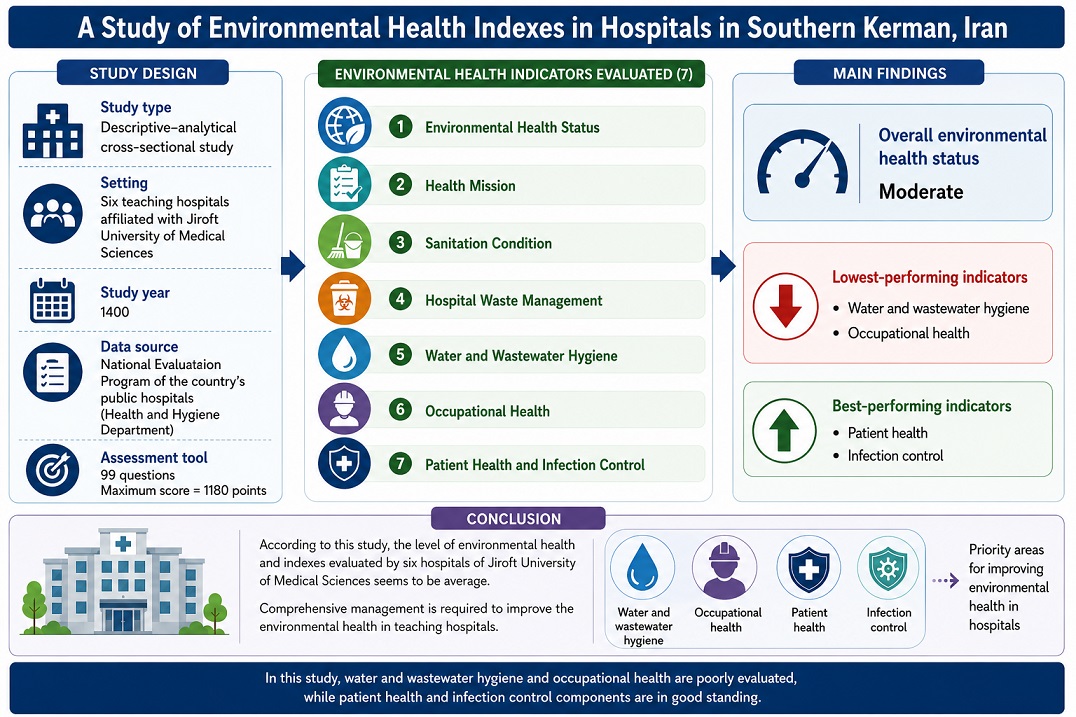
Background and Aim: Hospitals are fundamental components of healthcare systems and play an important role in providing medical care, preventing disease, and protecting population health. Monitoring environmental health indicators in hospitals is essential for identifying deficiencies and improving healthcare environments. This study aimed to assess environmental health indicators in six teaching hospitals affiliated with Jiroft University of Medical Sciences in southern Kerman Province, Iran.
Materials and Methods: This descriptive-analytical, applied, cross-sectional study was conducted in 2021. The study population consisted of six teaching hospitals affiliated with Jiroft University of Medical Sciences, and all hospitals were included using a census sampling method. Data were collected using the checklist of the National Evaluation Program of Public Hospitals (Health and Hygiene Department), which consisted of 99 questions with a maximum score of 1,180 points.
Results: The overall environmental health status of the six hospitals varied across the evaluated domains. Water and wastewater health and occupational health were among the least favorable domains, whereas patient health and infection control showed comparatively better performance. Hospital C had the highest overall score (1,144 points), while Hospital F had the lowest overall score (974 points).
Conclusion: The environmental health status of the evaluated teaching hospitals was generally at a moderate level. Particular attention should be given to water and wastewater management and occupational health. Regular assessment and targeted interventions may help address identified deficiencies and improve environmental health conditions in hospitals.
Graphical Abstract
Keywords
Subjects
 Environmental Health and Pollution Research
