Document Type : Original Article
Authors
1
Department of Environmental Planning, University of Tehran, Tehran, Iran
2
Environmental Health Research Center, Research Institute for Health Development, Kurdistan University of Medical Sciences, Sanandaj, Iran
3
Shahid Beheshti University of Medical Sciences, Tehran, Iran
10.22034/ehpr.2026.600899.1019
Abstract
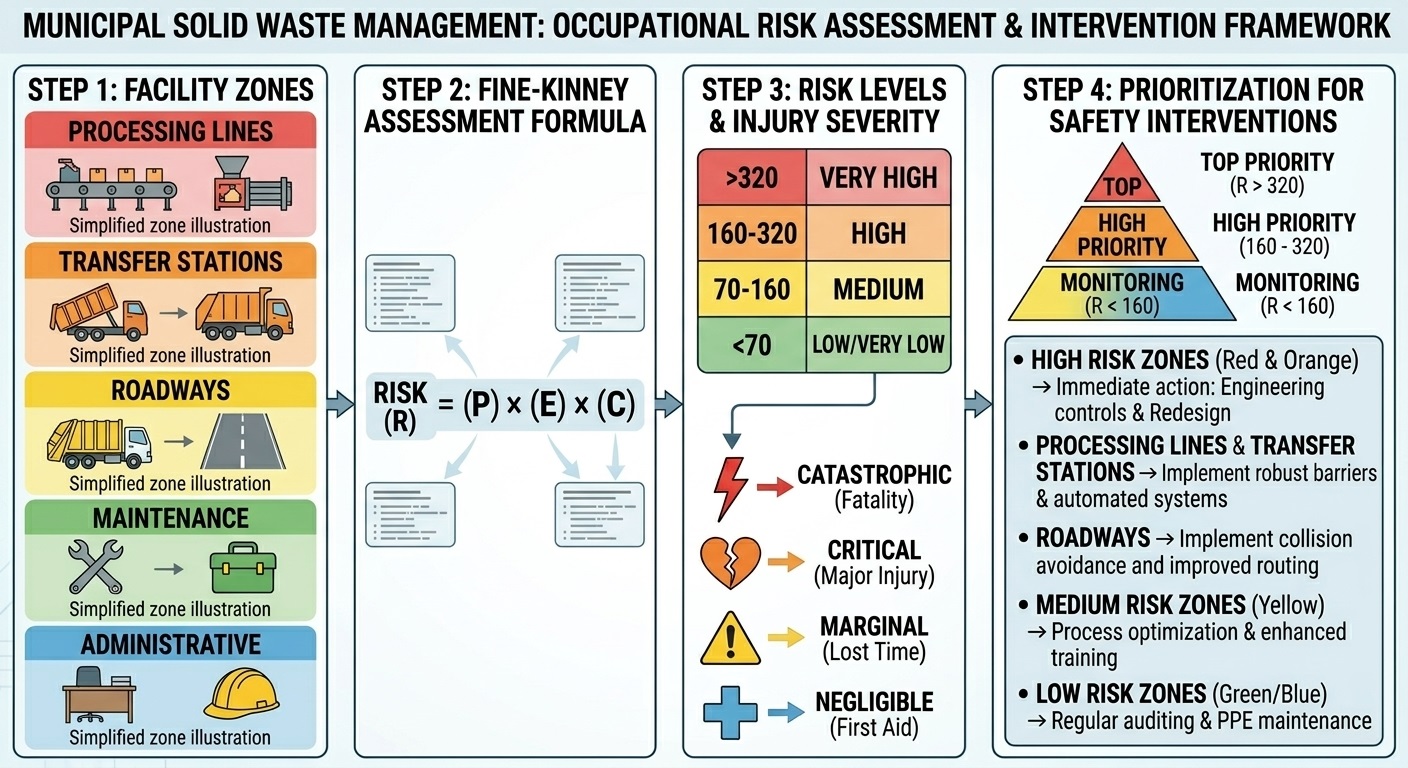
Municipal solid waste management (MSWM) carries the highest risk of occupational accidents. Few studies have systematically assessed accident risks in this field, in Iran. This study, based on accident records, evaluated 84 occupational accidents recorded over 12 years (2010–2022) at a single Iranian MSWM facility and classified them by location (processing lines, transfer stations, maintenance workshop, roadways, and administrative areas) and injury severity (catastrophic, very serious, serious, and minor). Occupational risk was assessed using the semi-quantitative Fine-Kinney method, and a prioritization framework was developed to rank zones for intervention. Of the 84 accidents, 4 (4.8%) were catastrophic (fatal), 6 (7.1%) were very serious (amputation or severe fracture), 59 (70.2%) were serious (requiring medical treatment) , and 15 (17.9%) were minor. The highest accident frequency occurred in processing lines (32.1%) and transfer stations (28.6%). Fine-Kinney analysis revealed the highest risk scores in processing lines (3600), transfer stations (3600), and roadways (900), all at very high-risk levels, while the administrative area scored lowest (100, medium risk). Severe incidents predominantly involved mechanical hazards and occurred in zones where engineering controls appeared to be limited. Processing lines, transfer stations, and roadways should therefore receive top priority for safety interventions. Integrating injury severity into risk assessment may offer a more informative basis for prioritization, particularly in zones where severe but infrequent events occur. The proposed prioritization framework may serve as a practical tool for targeted resource allocation at the study facility and, if validated in other settings, could be adapted to similar MSWM facilities.
Graphical Abstract
Keywords
Subjects
 Environmental Health and Pollution Research

