Department of Biology, Sanandaj Branch, Islamic Azad University, Sanandaj, Iran
Abstract
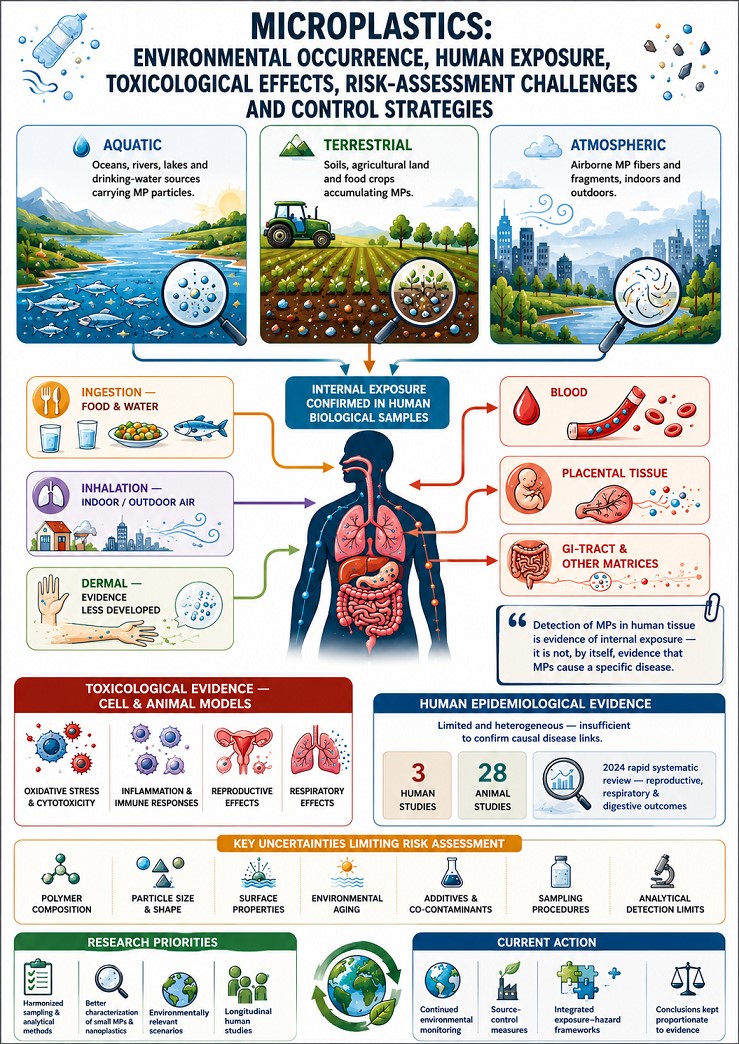
Microplastics (MPs) are plastic particles defined as smaller than 5 mm and are detected in aquatic, terrestrial and atmospheric environments, food, drinking water and human tissues. Their presence has raised concerns about environmental quality and potential effects on human health. This review examines sources, environmental distribution, human exposure pathways, toxicological evidence, analytical challenges and future health-risk assessment and management strategies. Available evidence indicates that ingestion and inhalation are principal exposure pathways, whereas evidence for dermal uptake remains less developed. MPs have been reported in human blood, placental tissue, gastrointestinal samples and other biological matrices, indicating internal exposure. However, detection in human tissues should not be interpreted as evidence that MPs cause specific diseases. Experimental studies have reported oxidative stress, inflammation, cytotoxicity, immune responses and reproductive or respiratory effects, but much evidence comes from cellular and animal models. Human epidemiological evidence remains limited and heterogeneous. A rapid systematic review published in 2024 identified only three human observational studies and 28 animal studies addressing reproductive, respiratory and digestive outcomes. Major uncertainties arise from differences in polymer composition, particle size and shape, surface properties, environmental aging, additives, associated contaminants, sampling procedures and detection limits. These limitations restrict comparisons among studies and complicate quantitative risk assessment. Future research should prioritize harmonized sampling and analytical methods, improved characterization of small MPs and nanoplastics, environmentally relevant exposure scenarios, longitudinal human studies and integrated exposure-hazard frameworks. Current evidence supports environmental monitoring and source-control measures, while conclusions regarding specific human diseases should remain proportionate to available evidence.
Rezaee, M. (2026). Contaminants: Environmental Occurrence, Human Exposure, Toxicological Effects, Risk Assessment Challenges, and Control Strategies. (e256294). Environmental Health and Pollution Research, 1(2), e256294
MLA
Rezaee, M. "Contaminants: Environmental Occurrence, Human Exposure, Toxicological Effects, Risk Assessment Challenges, and Control Strategies" .e256294 , Environmental Health and Pollution Research, 1, 2, 2026, e256294.
HARVARD
Rezaee, M. (2026). 'Contaminants: Environmental Occurrence, Human Exposure, Toxicological Effects, Risk Assessment Challenges, and Control Strategies', Environmental Health and Pollution Research, 1(2), e256294.
CHICAGO
Rezaee, M., "Contaminants: Environmental Occurrence, Human Exposure, Toxicological Effects, Risk Assessment Challenges, and Control Strategies." Environmental Health and Pollution Research, 1 2 (2026): e256294,
VANCOUVER
Rezaee M. Contaminants: Environmental Occurrence, Human Exposure, Toxicological Effects, Risk Assessment Challenges, and Control Strategies. Environ. Health Pollut. Res. 2026;1(2):e256294.
 Environmental Health and Pollution Research
