Evaluation of Cadmium Biosorption from Aqueous Solutions Using the Brown Alga Nizamuddinia zanardini and the Green Alga Ulva rigida

Document Type : Original Article

Authors
1 Department of Marine Biology, Faculty of Marine Sciences, Chabahar Maritime and Marine Sciences University, Chabahar, Iran
2 Department of Marine Biology, Faculty of Marine Sciences, Chabahar University of Maritime and Marine Sciences, Chabahar, Iran
Abstract
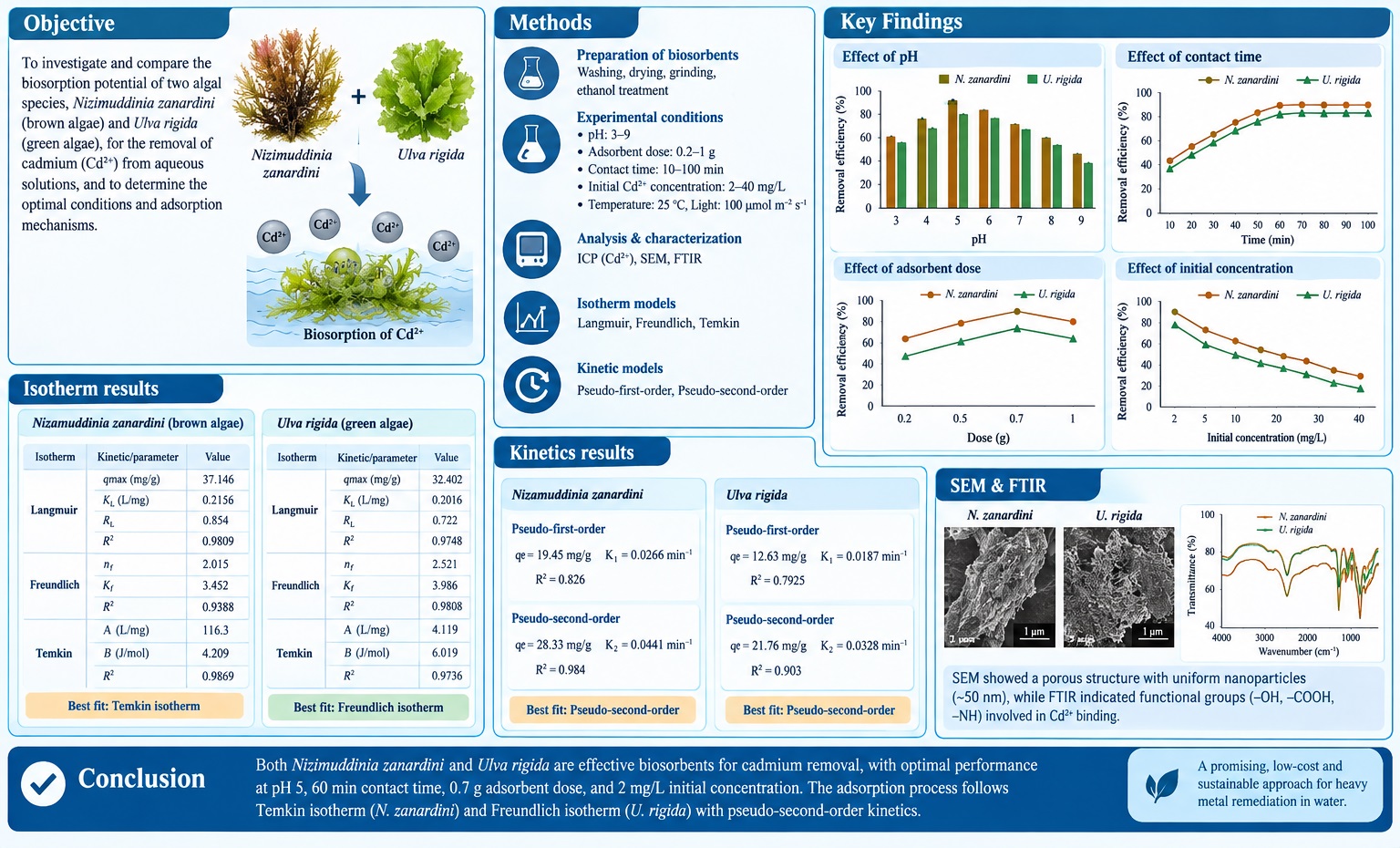
Pollution of water resources with heavy metals is a serious environmental problem. In this study, the biosorption of cadmium from aqueous solutions was investigated using dried biomass of the brown alga Nizamuddinia zanardini and the green alga Ulva rigida. The effects of pH (3–9), adsorbent dosage (0.2–1 g), contact time (10–100 min), and initial cadmium concentration (2–40 mg/L) were evaluated. The optimum conditions for both algae were pH 5, contact time 60 min, adsorbent dosage 0.7 g, and initial concentration 2 mg/L. Under these conditions, the maximum cadmium removal efficiencies were 94.3% for N. zanardini and 89.1% for U. rigida. The biosorption process by N. zanardini was best described by the Temkin isotherm (R² = 0.9869), while the Freundlich isotherm provided the best fit for U. rigida (R² = 0.9808). Both algae followed the pseudo-second-order kinetic model. The results indicate that both algal biosorbents have good potential for cadmium removal from aqueous solutions, with N. zanardini showing higher efficiency under the studied conditions.

Graphical Abstract

Evaluation of Cadmium Biosorption from Aqueous Solutions Using the Brown Alga Nizamuddinia zanardini and the Green Alga Ulva rigida
Keywords
Subjects

Volume 1, Issue 3
Summer 2026

  • Receive Date 07 October 2026
  • Revise Date 09 November 2026
  • Accept Date 09 November 2026
  • First Publish Date 09 November 2026
  • Publish Date 01 August 2026